
Secure by default, not by add-on.
Security is built into how the platform works: what can reach your servers, what runs on them, and what any single part could do if it were ever compromised.
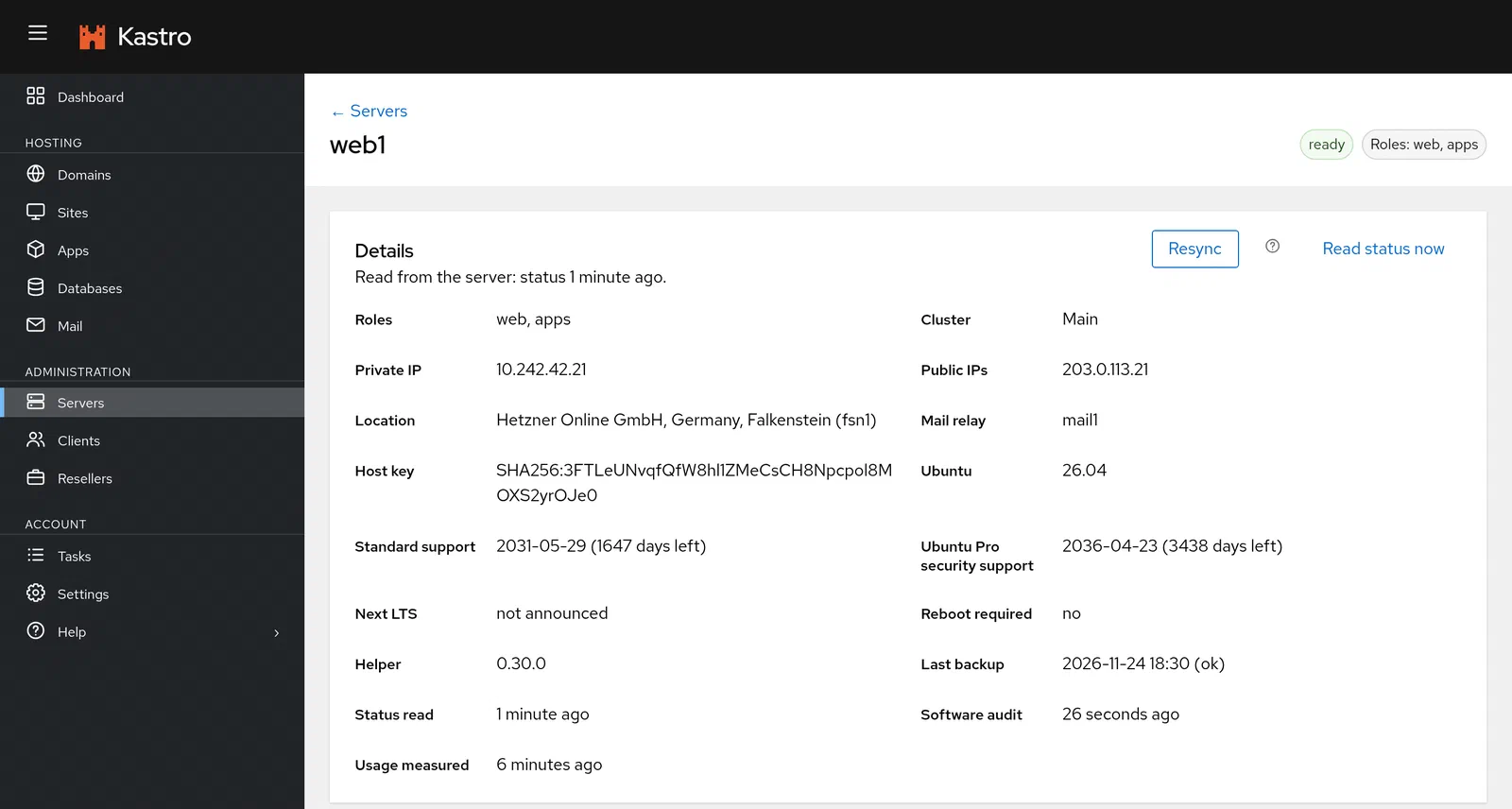
On every server
No agents, no shell
The panel reaches each server over SSH into a helper that knows 36 actions. Its key can do nothing else.
Pinned host keys
Every server's SSH host key is pinned in the panel, so the panel never talks to an impostor.
Stock packages, patched
Packages come only from the Ubuntu archive, security updates install automatically, and the panel shows pending reboots and remaining OS support.
A firewall that rolls itself back
Rules come from what actually runs on the server, and a change that cuts access reverts on its own after 60 seconds.
Keys, not passwords
SSH by key only, with brute-force protection and one approved list of administrator keys applied to every server.
Your servers only
Every client's cluster is private. No server is ever shared with another client.
For every site
Isolation
Its own Linux user, an SFTP jail and open_basedir, with dangerous PHP functions switched off.
Security headers
HSTS, nosniff, X-Frame-Options and Referrer-Policy, by default.
Nothing left lying around
Backup and include files such as .sql, .bak and .inc answer “not found”.
Cloudflare only
A site can refuse every request that doesn't come through Cloudflare, and unknown hostnames are always refused.
Protected folders
Password protection for staging copies, private downloads or admin areas.
HTTPS everywhere
Let's Encrypt certificates on every site, renewed every night.
Data and access
Encrypted in transit
Database traffic uses TLS and stays on the cluster's private network.
Encrypted, append-only backups
A compromised server can add snapshots but can never delete history.
Secrets stay secret
Passwords and application secrets are stored encrypted, and mail passwords only as hashes.
Two-factor sign-in
Required for administrators, available to every client.
No phpMyAdmin login page
phpMyAdmin opens only with a one-time ticket from the panel.
An audit trail
Every action in the panel is logged: who did what, and when.
Cloudflare in front
- WAF rules tuned for WordPress, Laravel and custom applications.
- Staging sites and admin tools behind Cloudflare Access sign-in.
- Origins that refuse any traffic not coming through Cloudflare.
- Admin tools reached through tunnels, with no open inbound port.
- DNS and CDN
- Cloudflare
- Direct origin access
- Refused, per site
- Admin tools
- Behind Cloudflare Access
- Rate limiting
- At Cloudflare
Questions
Who can log in to our servers?
Only Guru-host's administrators, with SSH keys from an approved list that is applied to every server. Your team gets SFTP to your sites and the client area.
What happens when a security update comes out?
Ubuntu security updates install automatically. When one needs a reboot, the panel flags it and we schedule the reboot.
Can you check our application's security too?
Yes. Our security audit reviews your code, APIs, access control and deployment, with prioritised findings and an optional retest.